


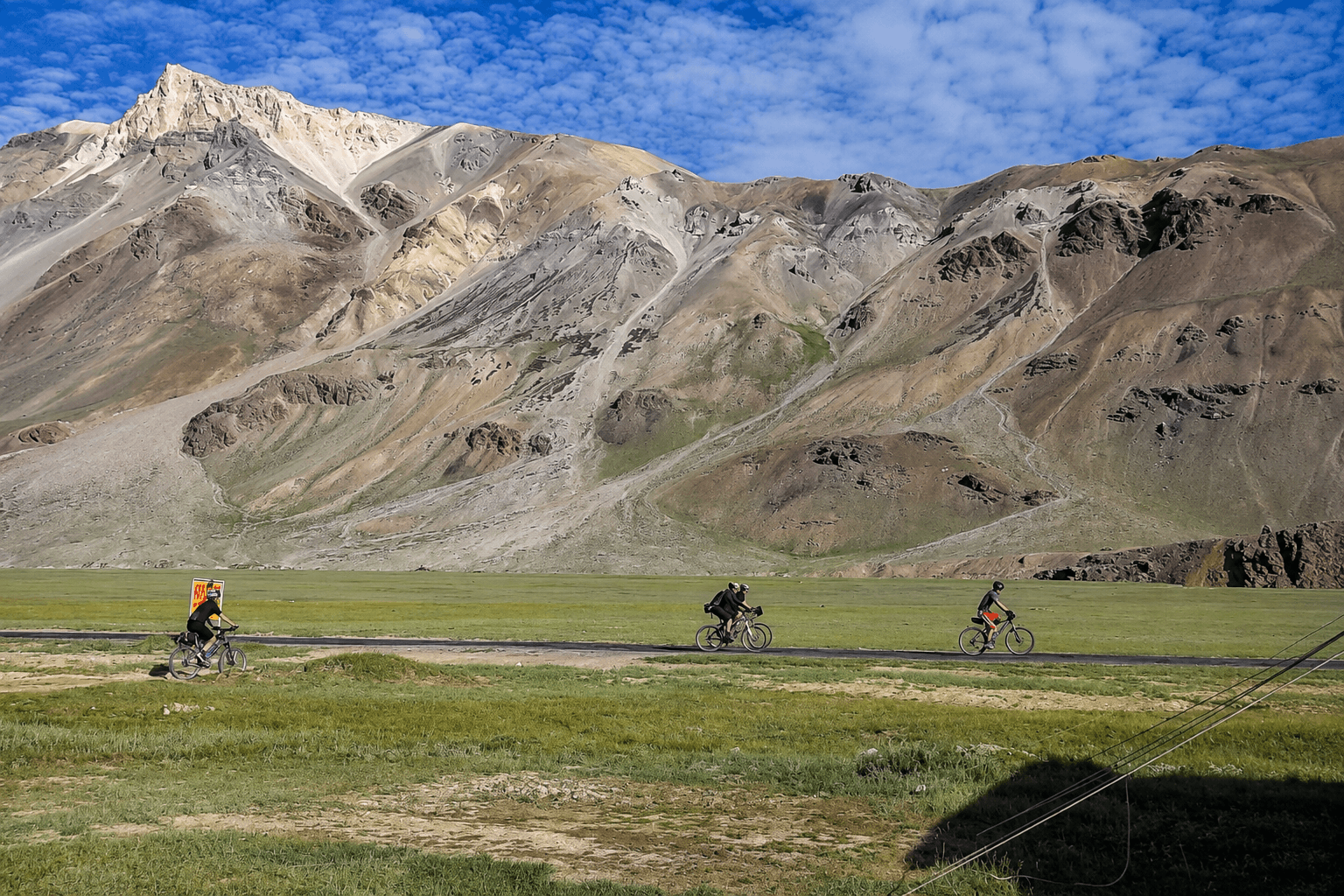
The Manali to Leh cycle tour is one of the world’s most iconic high-altitude cycling expeditions, crossing the dramatic heart of the Indian Himalaya from the green valleys of Himachal Pradesh to the stark high-altitude desert of Ladakh. Beginning in Manali, riders acclimatize before steadily ascending into remote mountain terrain where roads narrow, settlements disappear, and altitude defines the pace.
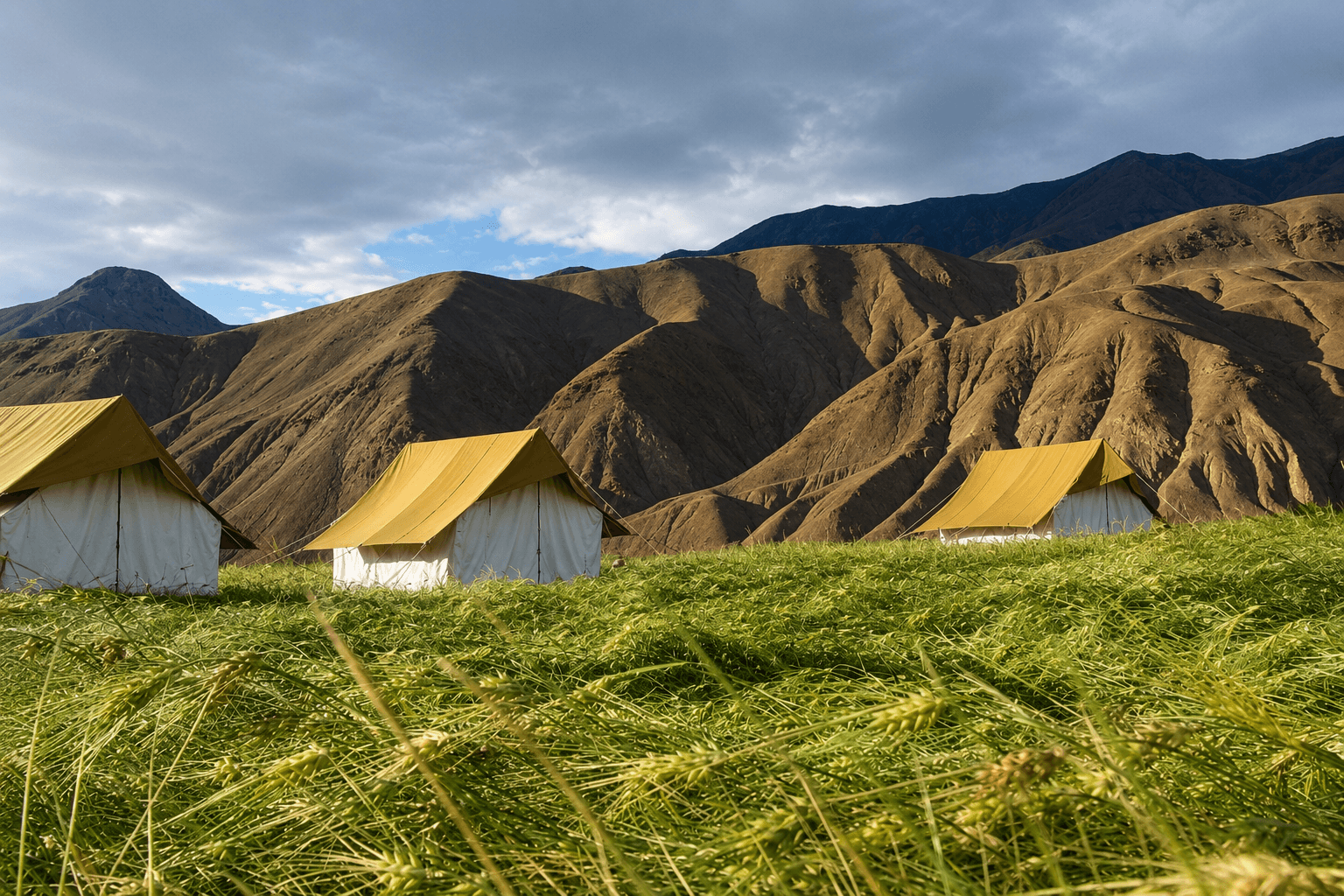
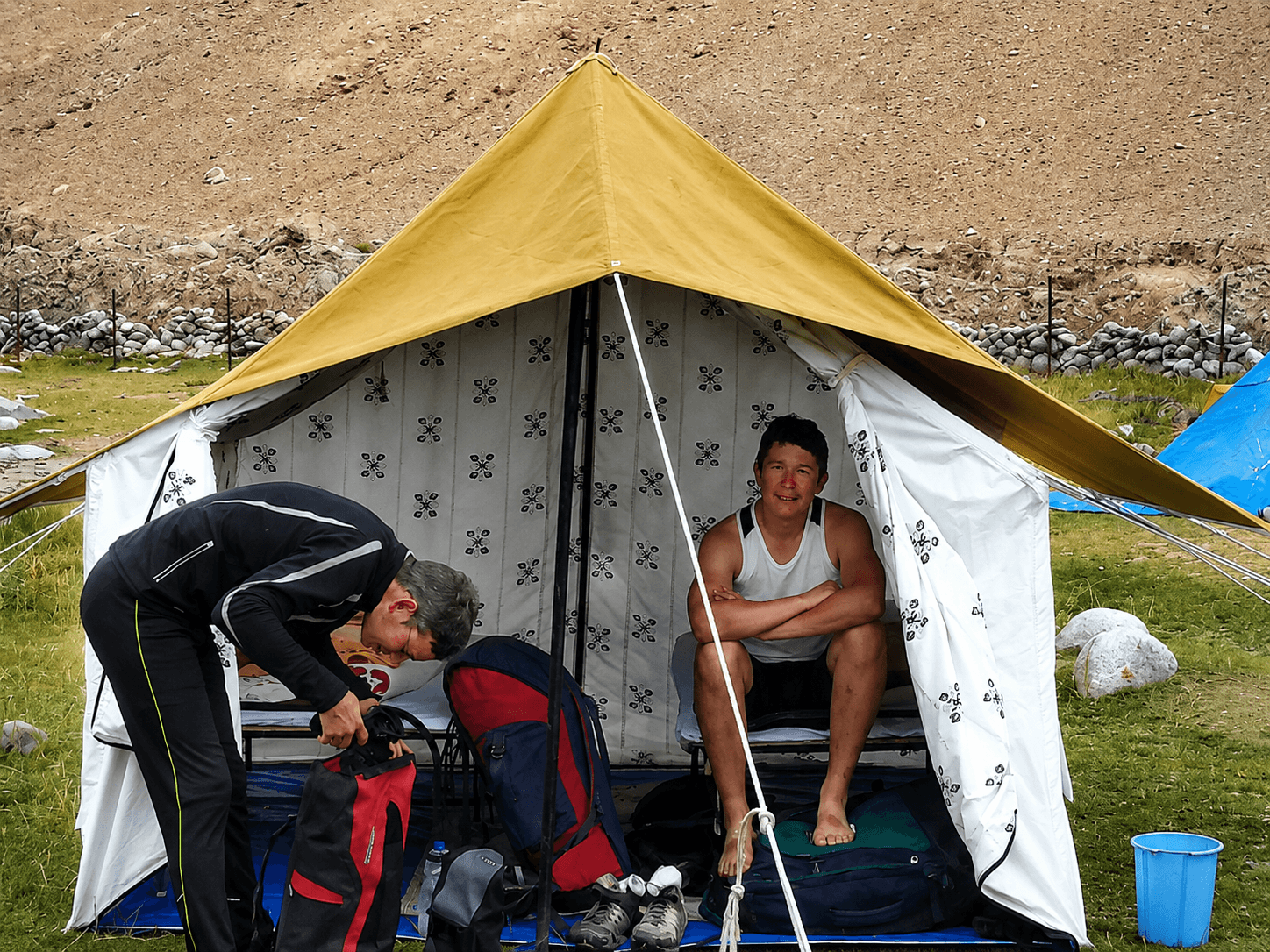
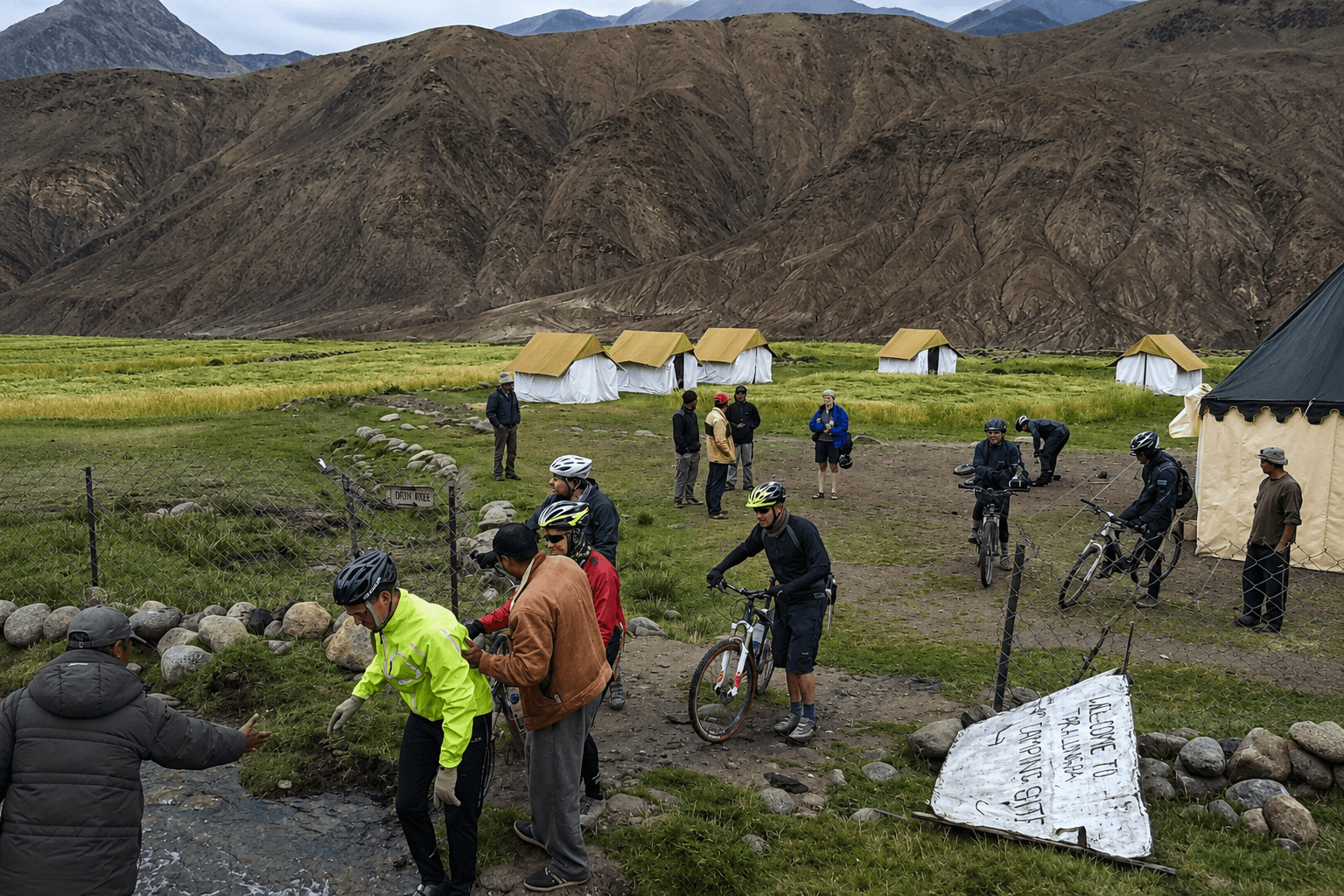
The route crosses some of the highest motorable passes on earth, including Rohtang Pass, Baralacha La, Nakee La, Lachulung La, and Tanglang La. These crossings test both physical endurance and mental resilience, with thin air, unpredictable weather, and long isolated stretches shaping the experience. Accommodation en route is largely in expedition-style camps, reinforcing the raw and immersive nature of the journey.
As the road descends toward Leh, vast plateaus and open skies replace steep climbs, marking the culmination of a demanding yet deeply rewarding expedition. Designed for experienced and physically fit cyclists, this is not a leisure ride but a true high-altitude journey that offers unmatched landscapes, personal achievement, and a profound connection with the Himalaya.
Adventure India started cycling from the initial years of 90s on this route and we started a charitable camp hospital at Sarchu in our first luxury resort here at 4100 meters during 1996-2000. Karl Ziegler, an enthusiast young cyclist and tour operator of Italy was our first support on this route with bulk groups and later we organized this exciting trip to CTC Holidays, Red Spokes of United Kingdom and many more international tour operators and individuals.
This programme has been crafted with insights drawn from our extensive history of exploratory journeys; however, we recognise that every traveller undertakes the same route with unique intentions, schedules, and philosophies of exploration. Accordingly, we remain fully flexible: whether you wish to condense the journey to its essential highlights or extend your time in any specific region for deeper immersion, reflection, or personal discovery.
Cost variations will naturally arise depending on the style of exploration you choose, whether minimalist and fast-paced or slow, immersive, and support-assisted. Finalising these details typically requires a thoughtful exchange of communication, as each group’s expectations must be carefully aligned with logistics, local arrangements, and on-ground support.
These tours have been successfully operated multiple times, and we are proud to have received wonderful testimonials reflecting our clients’ satisfaction.
Arrive in New Delhi, where you will be warmly welcomed at the international airport by our representative and your tour guide. They will accompany you to your hotel for check-in and an overnight stay. En route, or after you have settled in, your guide will provide a comprehensive briefing on the tour, including essential information, highlights, and the plan for the days ahead.
Hotel- Oberoi Maidens
Meal Plan - Room + Breakfast + dinner
Delhi to Chandigarh by train (3 hours) and drive to Manali (6 hours): We take the morning train Vande Bharat/ Shatabdi to reach Chandigarh- one of the most beautiful and planed city of India. From here we take road journey on well-maintained broad four lane road to Manali through several tunnels which are recently constructed.
Hotel- Eco Groves- Adventure India boutique hotel
Meal Plan - Room + Breakfast + dinner
In the morning, time is dedicated to assembling our bicycles and familiarizing ourselves with the bikes, Later, we cycle by gradually increasing our time in the saddle as we ride through the scenic Kullu Valley. The route takes us via Naggar, where we visit the historic Naggar Castle and stop for lunch. Passing through several small villages along the way, we continue cycling before returning to Manali in the evening, followed by a visit to the local market and dinner in town.
Hotel- Eco Groves- Adventure India boutique hotel
Meal Plan - Room + Breakfast + dinner
In the mountains, faith and nature are deeply intertwined, and before beginning our journey toward the high passes of Ladakh, a Buddhist monk performs a traditional blessing ceremony at the hotel, seeking protection and strength for the expedition ahead. With this quiet moment of reflection, we begin our ride from Manali onto the Manali–Leh Highway.
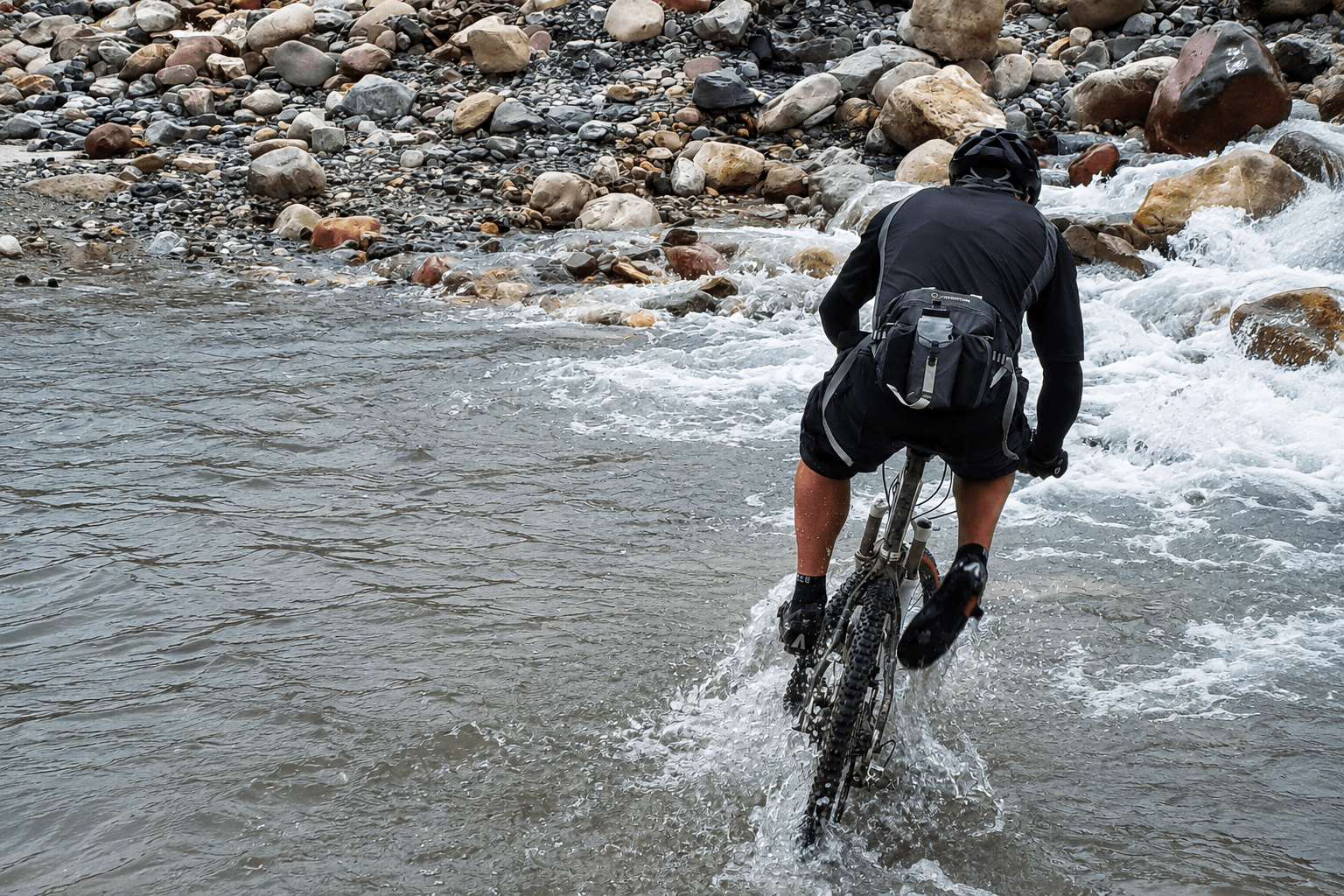
For the first few kilometers, the road rises gently, allowing riders to settle into a steady rhythm. Gradually, the ascent becomes more pronounced, and effort increases as the climb unfolds. Road conditions remain generally good, though in the final stretch before Marhi, meltwater streams often cross the road, carrying small stones and boulders from the surrounding slopes.
The landscape grows increasingly dramatic, with high, snow-capped mountains facing the road and countless mountain streams cascading downward, some resembling flowing ribbons of white against the dark rock. Near Gulaba, the terrain opens into meadows dotted with wildflowers and alpine herbs, adding unexpected colour to the ascent. As the road winds through a series of sweeping curves, the green Manali Valley gradually disappears behind us.
By afternoon, we arrive at Marhi, a small seasonal settlement with temporary establishments that remains buried under snow for nearly half the year. Our first night in the mountains is spent at a well-appointed luxury camp, marking the true beginning of the high-altitude expedition.
It is pertinent to mention here that we are not entering into Lahaul Valley by Atal Tunnel, but prefer to take the traditional route over Rohtang Pass to make our muscles perfect for the future high-altitude cycling.
Hotel- Camp
Meal Plan – All meals
Morning at Marhi is extremely fresh and vies are stunning, we leave our camp and ride for about 12 Kms straight to our first mountain pass, Rohtang La pass. The last 2 Kms are over an extremely old glacier of Rani Nalla and the views are fantastic with surrounding mountain peaks. Rohtang Pass is “must see destination for the Indian tourists” so is always covered with hundreds of tourists enjoying snow. The pass is spread in a huge area and the road from the pass to another side is extremely nice in the beginning. One can watch the CB Ranges facing to him, the high mountains & peaks on Lahul side and the barren valley leading towards Spiti- the forbidden land in the Trans Himalayas. We reach to Koksar after 19 Kms downhill cycling, the place to register yourselves and the place to eat also. Now we are in the Lahul valley, which is a house of two religions under one roof, Buddhism and Hindu. The road moves along the biggest river of the state, Chandra and through Sissu and Gondhla, we reach Tandi on the foot hills if Pir Panjal Ranges. Tandi is the meeting point of two rivers, Chandra (coming from Spiti valley) and Bhaga (coming from Baralacha), the both rivers meet here and flow towards Pakistan with the name of Chenab. We see the runs of Gondhla Fort before reaching Tandi and from there; Keylong is one more hour ride. We reach Keylong, the headquarter of Lahul & Spiti and check into our hotel.
Hotel- Tashi Delek Hotel
Meal Plan - Room + Breakfast + dinner
This day is relatively easy as we don’t have any pass to cross and even the distance is also not much. On the route, which is dusty and rocky, we can stop at a small monastery of Jispa and later after 5 Kms; we reach Darcha- the base camp for the popular trekking routs to Zanskar. From here we cross a bridge and start an ascent to Patseo. We now get a sense of the isolation of the area, with a few sheep dotted around and we begin to enter the territory of the Lamas. In the far horizon you can see the bleak and awesome spectacle of the Higher Himalayan ranges. Patseo is a open ground where till 1960 a temporary office of the Government of India was functional to control the trade on silk route between India and Tibet. The ground was the place of trade exchanges in ancient times but today it is used by the Indian army as its base for Ladakh, both the store the commodities and secure the boundaries. The campsite is beautiful and you can enjoy the evening nicely
Arrive in New Delhi, where you will be warmly welcomed at the international airport by our representative and your tour guide. They will accompany you to your hotel for check-in and an overnight stay. En route, or after you have settled in, your guide will provide a comprehensive briefing on the tour, including essential information, highlights, and the plan for the days ahead.
Hotel- Camp
Meal Plan – All meals
Today presents one of the major challenges of the expedition as we ride toward and across Baralacha La Pass. The climb is long and demanding, but the vast, silent landscape offers a quiet kind of support. In this remote terrain, isolation becomes complete, and the bond with the bicycle deepens, it is no longer just equipment, but a trusted companion carrying you through the heart of the mountains.
The real ascent begins from Zing Zing Bar; a desolate outpost whose unusual name has nothing to do with hospitality and everything to do with the imagination of soldiers stationed in this stark environment. As the climb continues, the route passes places with names like Whisky Nalla, Brandy Nalla, and Bharatpur City invented by road construction crews to break the monotony of life in this barren high-altitude wilderness. For centuries, this land saw only monks, shepherds, and traders moving quietly toward Tibet.
Near the summit of Baralacha La lies Suraj Tal, the “Lake of the Sun,” a striking high-altitude water body shimmering beneath the surrounding peaks. From here, the road finally begins its descent, opening into the wide valley of Sarchu. After passing Kelang Sarai, we arrive at our fixed campsite, where we rest for the night under open skies, having crossed yet another formidable Himalayan threshold.
Hotel- Camp (Fixed)- Adventure India started luxury camping here in 1997
Meal Plan – All meals
Leaving Sarchu, the day begins with a few kilometers of relatively flat riding, allowing riders to find their rhythm before the real challenge unfolds. Soon, the road rises sharply into the dramatic canyon walls through the legendary Gata Loops—a series of 21 tight zigzags climbing steadily to an altitude of about 15,030 feet. The ascent is demanding and relentless, requiring controlled pacing and mental focus.
From the top, we cross Nakee La Pass and begin a long, gradual descent toward Whisky Nalla. Throughout the day, the route passes through stark, high-altitude desert landscapes, where vast open spaces, barren mountains, and shifting light define the scenery. By late afternoon, we arrive at Whisky Nalla, where our campsite awaits, offering a well-earned rest after another challenging and memorable day in the high Himalaya.
Hotel- Camp
Meal Plan – All meals
We start the day by climbing the series of zigzag bends rising directly above our campsite, steadily ascending toward Lachulung La, one of the highest passes on the Manali–Leh highway. Much of the road surface has been newly paved, with only a few remaining rough sections along the way. From the pass, the route drops sharply, descending through a steep-sided gorge before easing briefly.
This is followed by an eight-kilometer switchback climb that leads us onto the vast, flat expanse of the Morey Plains. This stark high-altitude plateau is known for its extreme temperature shifts between morning and evening, frequent strong winds, and occasional sandstorms. Despite the harsh conditions, nomadic Changpa communities can sometimes be seen grazing yaks and sheep across this remote landscape.
Crossing the plains, we enjoy mostly gentle downhill cycling on an unusually smooth road, complete with a painted centre line. Toward the end of the day, we leave the main road and follow a rough sandy track for about five kilometers, finally reaching our campsite near the quiet shores of the Tso Kar Salt Lake.
Hotel- Camp
Meal Plan – All meals
Today brings one of the defining challenges of the journey as we climb toward Tanglang La, the world’s second-highest motorable pass at 5,328 metres. The ascent is demanding, yet the well-maintained, largely sealed road allows for steady progress. Reaching the summit is a deeply rewarding moment, marking both physical effort and mental resolve.
From the top, we begin an exhilarating descent of nearly 1,200 metres, winding down a series of sweeping switchbacks toward the village of Rumptse. As the road drops, the landscape gradually softens, passing through a handful of small settlements and entering more fertile, inhabited terrain. The air grows noticeably warmer as we continue riding to Lato, a village tucked beneath towering rock faces, where the day’s journey ends
Hotel- Camp
Meal Plan – All meals
The ride from Lato to Leh marks a gentler yet deeply satisfying final stage of the Manali–Leh cycling expedition. Starting from Lato at approximately 3,500 metres, the route follows the broad Indus Valley, where gradients ease and the terrain becomes more forgiving compared to the high passes crossed earlier. The day involves rolling terrain with long gradual descents, allowing riders to settle into a smooth rhythm and enjoy the ride.
As the journey continues, the Indus River accompanies the road, and the landscape slowly transforms from stark wilderness to more inhabited and fertile surroundings. Small Ladakhi villages appear along the way, with cultivated fields, whitewashed houses, and fluttering prayer flags adding life and colour to the valley. The air feels warmer, and breathing becomes noticeably easier as altitude stress fades.
The final kilometers lead steadily into Leh, Ladakh’s cultural and administrative centre. Roads widen, movement increases slightly, and the sense of arrival builds with every turn. Reaching Leh is more than the end of a cycling day, it is the culmination of a demanding high-altitude expedition, achieved through endurance, discipline, and respect for the mountains.
Hotel- Hotel Gawaling
Meal Plan – Breakfast + Dinner
This is the day to relax yourself, have small walks in the market and we organize visits to few monasteries this day to experience Leh.
Hotel- Hotel Gawaling
Meal Plan – Breakfast + Dinner
Today brings another defining challenge as we ride toward Khardung La Pass, one of the highest motorable mountain passes in the world. The climb begins steadily from Leh, gaining altitude through a dramatic high-desert landscape where every kilometre demands focus and controlled effort. Riding at this elevation is as much a mental test as a physical one.
From the summit, the reward is extraordinary. The panorama stretches south across the Indus Valley and unfolds northward toward the vast ridges of the Zanskar Range and the towering peaks of the Saser Massif. Khardung La serves as the gateway to the Nubra Valley, and reaching this point by bicycle is a rare and unforgettable achievement.
After spending time at the top to absorb the scale and silence of the mountains, we begin our descent back to Leh. The return ride feels lighter, carrying with it the satisfaction of having reached one of the great milestones of Himalayan cycling, often the very reason many riders choose to undertake this expedition.
Hotel- Hotel Gawaling
Meal Plan – Breakfast + Dinner
After breakfast, we transfer to Leh Airport for your flight to Delhi. The one-hour journey offers spectacular aerial views of the Himalaya before descending into the plains. Upon arrival in Delhi around midday, you are transferred to your hotel for some rest.
In the afternoon, an optional half-day guided tour of Delhi can be arranged. In the evening, a farewell gala dinner is hosted, after which we provide a transfer to the international airport for your onward flight home.
Hotel- Pride Plaza
Meal Plan – Breakfast + Dinner
Departure Transfer
2200 US$ per person (based on a minimum group size of six participants)
Terms and Conditions
1. Eligibility: Fitness, Experience & Motivation
All participants must be physically fit, technically prepared, and mentally motivated for high-altitude climbing. Your mountaineering résumé and experience records will be reviewed before we submit the team application to the Indian Mountaineering Foundation (IMF).
While peaks above 7,000 m demand exceptional stamina and technical competence, numerous Himalayan summits below 6,000 m are equally challenging due to route complexity, weather exposure, remoteness, and objective hazards.
2. Delayed Departure & Early Closure
Expedition timelines may shift due to weather, route conditions, medical concerns, permit directives, or the leader’s safety decisions.
- Delayed closure: Any extension of the itinerary will incur additional charges.
- Early pack-up/retreat: Should the expedition conclude earlier than scheduled, no refund will be provided.
- Any extra transport, hotel stay, lodge/camp nights, or logistical support arising out of delays, roadblocks, medical evacuation, or administrative regulation will be billed separately on a cost-to-cost basis.
3. Satellite Phones, Filming & Drone Permissions
Satellite communication devices are subject to regional security restrictions and cannot be used freely across the Himalaya.
- Only company-registered satellite phones may be used, and will be provided on additional rental in the areas allowed by the Indian Government.
- Drone operations, documentary filming, and aerial recording require prior permits, which vary by district, border zone, and wildlife protection area.
All protocols must be strictly followed to avoid administrative intervention or penalties.
4. Refund Policy
All refund considerations will follow the official cancellation policy issued along with your expedition dossier. Refunds, where applicable, will be processed only as per those terms.
5. Health, Insurance, Rescue & Indemnity
Participants must hold valid high-altitude insurance, including evacuation coverage.
- Any emergency medical service, evacuation helicopter, ground rescue, insurance activation, or hospitalisation can be coordinated through us in the knowledge of LO, but must be paid directly by the team or the insurer.
- All members are required to sign an Indemnity & Risk Acceptance Bond with Adventure India before departure.
6. Booking Confirmation
Once all expedition details, services, and logistics are finalised, the following payment schedule applies:
- 50 % of the expedition fee + IMF fee at the time of confirmation
- Remaining balance payable 61 days before expedition commencement
- 100% advance payment is required for last-minute bookings (booking within 61 days before departure)
7. Non-Refundable / Non-Credit Services
Expedition pricing is quoted as a complete logistical package, not as itemised services.
Therefore, no partial refunds, credits, or adjustments will be issued for unused services (e.g., unused load-ferry, camp nights, high-altitude rations, guide days, transport segments, etc.).
We strongly recommend purchasing full travel cancellation insurance at the time of booking.
8. Replacement Participant
If you nominate another climber to take your place:
- All cancellation charges will be fully waived provided:
- The replacement climber meets the fitness and mountaineering requirements, and
- Secures IMF approval and permit to climb the peak.
9. Sightseeing & Post-Expedition Extensions
Following intense climbing periods in remote high-altitude environments, we encourage participants to decompress and experience India’s cultural and natural richness.
Extension trips may be arranged at additional cost to:
- Taj Mahal / Agra
- Rajasthan Desert & Fort Circuit
- Ladakh & Trans-Himalaya Culture
- Goa / Konkan Coast
- South India (Kerala, Tamil Nadu, Karnataka)
- Northeast India or custom destinations
Cancellation policy
| Cancellations made more than 60 days before departure | A cancellation fee of 10% of the total trip cost will be charged, and the remaining amount will be refunded. |
| Cancellations made between 45 and 60 days before departure | A cancellation fee of 25% of the total trip cost will be charged, and the remaining amount will be refunded. |
| Cancellations made between 30 and 45 days before departure | A cancellation fee of 50% of the total trip cost will be charged, and the remaining amount will be refunded. |
| Cancellations made less than 30 days before departure | The entire deposit will be forfeited. |
UIAA Declaration
UIAA or TREKKING SCALE AS PER THE GLOBAL STANDARDS
The grading of the Kang La Pass trek needs to be understood through two different lenses, as global standards distinguish between technical climbing difficulty and trekking difficulty. The UIAA scale, established by the UIAA, is primarily designed to measure technical rock-climbing challenges rather than trekking routes. Since Kang La does not involve any technical climbing elements—such as the use of ropes, harnesses, or protective gear—it falls under the category of “UIAA Grade 0,” meaning non-technical. In essence, it is considered an alpine hike rather than a climb.
However, for trekkers, the more relevant classification comes from international trekking scales, which evaluate routes based on altitude, endurance, terrain, and remoteness. Systems such as the Alpine grading used in Europe, IFMGA/UIAA trekking categories, and global adventure travel grading frameworks all place Kang La in the “Difficult” or “Demanding” category. This reflects not technical complexity, but the physical and environmental challenges encountered along the route.
From a global perspective, the trek’s difficulty becomes clearer when broken down into its key components. At an altitude of approximately 5,300 meters, Kang La firmly falls within the realm of very high-altitude trekking, where reduced oxygen levels significantly affect physical performance. The trek typically spans 8 to 10 days, with long walking hours of 5 to 8 hours each day, requiring sustained stamina and resilience.
The terrain further adds to the challenge. Trekkers must negotiate river crossings, loose moraine, scree slopes, and steep ascents and descents over the pass, all within remote valleys that demand careful footing and awareness. While none of these require technical climbing skills, they collectively create a physically demanding environment. The remoteness of the Zanskar side enhances the seriousness of the trek, as evacuation options are limited, giving the journey an expedition-like character.
In terms of global equivalence, Kang La is consistently classified as non-technical (UIAA Grade 0) but T4–T5 (demanding to very demanding) on the Alpine trekking scale, and simply “Difficult” under both international and Indian trekking gradings. Despite this, the trek often feels harder than its classification suggests. The combination of high altitude, thin air, long remote stretches, and unpredictable mountain weather can significantly increase the perceived difficulty. As a result, many trekkers underestimate Kang La simply because it is labeled “non-technical,” when in reality it demands strong endurance, proper acclimatization, and mental resilience.