


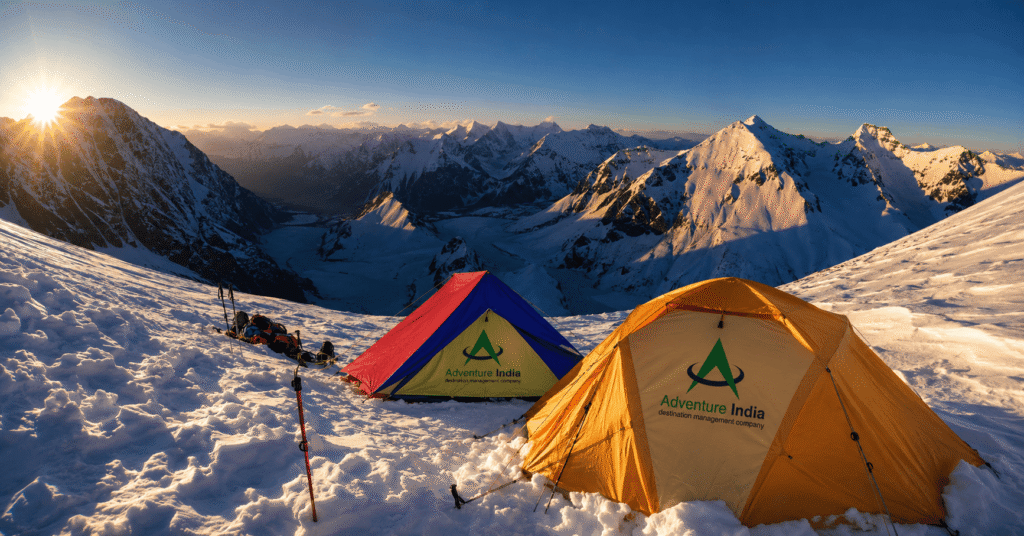
Scaling 6,831 Meters in the Garhwal Himalaya
Rising above the legendary Gangotri Glacier basin, Kedar Dome (6,831 m) is one of the most elegant and sought-after mountaineering objectives in the Garhwal Himalaya. A subsidiary summit of the imposing Kedarnath massif, the peak dominates the skyline above Tapovan and Nandanvan, presenting an impressive snow-clad pyramid framed by the towering peaks of Shivling, Meru, and the Bhagirathi Group. Owing to its altitude, glaciated terrain, and moderate technical difficulty, Kedar Dome has long been regarded as one of the finest preparatory peaks for climbers aspiring to higher Himalayan objectives above 7,000 metres.
The mountain was first climbed in 1947 by the Swiss expedition led by André Roch, who pioneered the route via the northwest flank that remains the standard line of ascent today. Since then, Kedar Dome has earned a distinguished place in Himalayan mountaineering history. Notable achievements include the first ascent of its formidable East Face by a Hungarian team in 1989, pioneering ski descents by members of the Indo-Tibetan Border Police and Indian Air Force during the 1970s, and its continued use as an advanced training peak by leading mountaineering institutes. While the normal route offers an excellent introduction to high-altitude expedition climbing, the East and Southeast Faces remain serious alpine challenges involving steep mixed terrain of rock, ice, and snow.
Adventure India has a long and proud association with Kedar Dome. During the mid-2000s, we organised and led one of the region’s pioneering all-women Austrian expeditions, followed by an Italian women’s expedition in 2012 under the leadership of Monica Bez. Among our most celebrated achievements was the Austrian ski descent from Kedar Dome by Andreas and Sissi, an expedition that attracted international attention and showcased the mountain’s potential for innovative alpine exploration. This programme is dedicated to these accomplished climbers and to all those who continue to push the boundaries of Himalayan mountaineering with skill, determination, and grace.
On your arrival at Delhi international airport, our office staff, most likely your base camp manager will come to receive you and assist you in smooth check in to a hotel centrally located. From here you will find easy to explore Delhi and reach IMF next morning for the briefing. We host the welcome dinner this day in Delhi followed by a casual discussion about your expedition.
Hotel/ Camp- Oberoi Maidens
Meal Plan - Room + Breakfast + welcome dinner
As per the schedule provided by the Indian Mountaineering Foundation (IMF), our team will escort you to the IMF headquarters for the official expedition briefing and completion of formalities. Following the briefing, there will be time for any last-minute purchases of personal supplies or expedition essentials before we begin our journey to Rishikesh. A hot lunch will be served en route.
Nestled on the banks of the sacred River Ganga and surrounded by the foothills of the Himalaya, Rishikesh is one of India's most revered spiritual destinations. Often referred to as the Yoga Capital of the World, the town has long attracted saints, pilgrims, yogis, and seekers from across the globe. According to Hindu tradition, Rishikesh is associated with Lord Shiva and is also believed to be the place where Lord Rama performed penance after the battle of Lanka. The serene atmosphere, flowing Ganga, and forested hills create an environment ideal for reflection and spiritual contemplation.
Upon arrival, we explore some of Rishikesh's most iconic landmarks like Lakshman Jhula, a historic suspension bridge across the River Ganga, offering beautiful views of the river, temples, and surrounding hills; and Triveni Ghat, as the most sacred ghat in Rishikesh, renowned for its evening Ganga Aarti, a captivating ceremony of prayers, chanting, and floating lamps on the river. After witnessing the evening Aarti, return to the hotel for dinner and overnight stay.
Hotel/ Camp- Vasundhara Palace
Meal Plan - Half Board
After breakfast, we drive from Rishikesh to Uttarkashi through the scenic valleys of the Garhwal Himalaya. The road follows the course of the Bhagirathi River and passes through several picturesque mountain towns. Narendra Nagar, located about 15 km from Rishikesh, offers excellent views of the Ganga Valley. Further ahead, we pass Chamba and Dharasu, an important road junction from where the route to Yamunotri diverges. As we approach Uttarkashi, the Bhagirathi River accompanies us through a spectacular mountain landscape.
Uttarkashi (1,158 m) is the principal mountaineering and adventure hub of the Garhwal Himalaya and serves as the gateway to the Gangotri region. Upon arrival, we check into our hotel and complete the remaining expedition formalities. Most permit and wildlife-related clearances will already have been processed by our advance team, but some final documentation may be completed today.
The afternoon is dedicated to expedition preparations. You will meet the mountain guides, cooks, and support staff, and inspect the climbing and camping equipment. Any rented technical gear can be checked and fitted at our office. Participants are encouraged to communicate their equipment requirements well in advance to ensure availability.
You will also receive the necessary permits and expedition documents. If required, satellite phones, walkie-talkies, and drone permissions can be arranged, subject to government regulations and prior approval. Requests for such communication and filming equipment should be made well in advance of the expedition.
Hotel/ Camp- Ganga Palace
Meal Plan - Full Board
After breakfast, we drive upstream along the Bhagirathi Valley towards the sacred pilgrimage town of Gangotri. The route passes through the charming Himalayan villages of Bhatwari, Gangnani, Harsil, and Dharali, offering magnificent views of snow-clad peaks, dense deodar forests, and the emerald waters of the Bhagirathi River.
Gangotri, situated at an altitude of 3,048 metres, is one of the most revered pilgrimage centres in India and an important destination in the Char Dham Yatra. Upon arrival, we visit the sacred Gangotri Temple and perform prayers for the safety, well-being, and success of the expedition team. The present temple is believed to have been built in the early 19th century by the Gorkha commander Amar Singh Thapa and later renovated by the Maharaja of Jaipur.
According to Hindu tradition, Gangotri is the seat of Goddess Ganga and marks the place where the sacred river descended from heaven to earth through the penance of King Bhagirath. Although the river is known as the Bhagirathi in its upper reaches, it assumes the name Ganga after its confluence with the Alaknanda River at Devprayag.
The true source of the river lies at Gaumukh, the snout of the Gangotri Glacier, approximately 18 km from Gangotri. This glacier is among the largest in the Himalaya and forms the gateway to some of India's most celebrated mountaineering and trekking regions, including Tapovan, Nandanvan, Shivling, Meru, and the Bhagirathi peaks.
The remainder of the day is free for acclimatization, a leisurely walk around the temple town, and final preparations for the trek ahead.
Hotel/ Camp- Mandakini Hotel
Meal Plan - Full Board
After breakfast, and subject to temple opening hours, we may visit the sacred Gangotri Temple before commencing our trek into the upper Bhagirathi Valley. The well-defined trail follows the true right bank of the Bhagirathi River, gradually ascending through a landscape of pine forests, rocky cliffs, and magnificent Himalayan scenery.
The first section of the trek leads to Chirbasa (approximately 9 km from Gangotri), whose name literally means "the abode of pine trees." Beyond Chirbasa, the valley opens dramatically, revealing spectacular views of the Bhagirathi I, II, and III peaks. The tree line gradually disappears, giving way to a rugged high-altitude environment of moraines, alpine vegetation, and glacial landscapes.
Continuing along the river, we arrive at Bhojbasa, named after the Bhojpatra (Himalayan Birch) trees that once flourished in the area. Situated at an altitude of 3,790 metres, Bhojbasa is the last major camping ground before Gaumukh and offers some of the finest mountain views in the Gangotri region.
Upon arrival, we settle into camp and enjoy time to relax and acclimatize. In the evening, weather permitting, witness a spectacular sunset illuminating the towering Bhagirathi massif, one of the most impressive mountain panoramas in the Indian Himalaya.
Hotel/ Camp- Adventure India Trekking Camp
Meal Plan - Full Board
The morning at Bhojbasa offers one of the most inspiring panoramas in the Garhwal Himalaya. As the first rays of sunlight illuminate the magnificent Bhagirathi I (6,856 m), Bhagirathi II (6,512 m), and Bhagirathi III (6,454 m), the campsite is transformed into a natural amphitheatre of snow-clad peaks and glacial landscapes. After breakfast, we begin our trek towards Gaumukh (approximately 4 km; 4,000 m), the sacred snout of the Gangotri Glacier and the traditional source of the Bhagirathi River, one of the principal headwaters of the Ganges.
The trail to Gaumukh follows the true left bank of the Bhagirathi Valley through a dramatic high-altitude landscape of glacial debris and barren mountain slopes. Upon reaching Gaumukh, trekkers are rewarded with a close view of the immense Gangotri Glacier, one of the largest glaciers in the Indian Himalaya, stretching nearly 30 kilometres into the heart of the Gangotri massif. The name "Gaumukh," meaning "Cow's Mouth," derives from the shape once formed by the glacier's snout. After spending time exploring this sacred and awe-inspiring location, we leave the main pilgrimage route and begin the ascent towards Tapovan.
The climb from Gaumukh to Tapovan is the most demanding section of the day, involving a steep ascent over glacier moraine, rocky slopes, and boulder-strewn terrain. Depending upon glacier conditions, the route may require crossing sections of the Gangotri Glacier before ascending a well-established trail to the meadow above. As altitude is gained, breathtaking views unfold of Shivling (6,543 m), often described as one of the most beautiful mountains in the world, along with Meru (6,660 m), the Bhagirathi Group, Sudarshan Parbat, and the vast Gangotri Glacier below.
By afternoon, we arrive at Tapovan (4,463 m), a spectacular alpine meadow situated at the foot of Shivling Peak. Renowned as one of the finest high-altitude campsites in the Himalaya, Tapovan is a place of extraordinary beauty where lush grasslands, glacial streams, and seasonal wildflowers contrast dramatically with the surrounding ice-clad peaks. The area has long been a place of meditation for Hindu sages, and its name translates as "Forest of Austerities" or "Sacred Grove of Meditation." Wildlife enthusiasts may be fortunate to spot Bharal (Blue Sheep) grazing on the surrounding slopes, while Himalayan griffons and other high-altitude birds are frequently seen soaring overhead.
Upon arrival, we settle into camp and enjoy an evening surrounded by some of the most iconic peaks of the Gangotri region. The sunset and alpenglow on the face of Shivling provide an unforgettable conclusion to one of the most spectacular trekking days in the Himalaya.
Hotel/ Camp- Adventure India Trekking Camp
Meal Plan - Full Board
Today is reserved for rest and acclimatisation at Tapovan (4,463 m), one of the most spectacular high-altitude meadows in the Indian Himalaya. Nestled at the foot of the magnificent Shivling Peak (6,543 m / 21,467 ft), Tapovan is renowned for its extraordinary setting amidst glaciers, alpine grasslands, and some of the most iconic mountains of the Garhwal Himalaya. The name Tapovan is derived from the Sanskrit words, meaning "Forest of Meditation" or "Sacred Grove of Spiritual Practice."
Although situated above the tree line in a rugged glacial environment, Tapovan surprises visitors with its broad alpine meadows nourished by glacial streams descending from the surrounding peaks. The campsite offers uninterrupted views of Shivling, often described as the most beautiful mountain in the Garhwal Himalaya, as well as Meru (6,660 m), the Bhagirathi Group, Kedar Dome (6,831 m), and the upper reaches of the Gangotri Glacier. During the summer months, the meadows are dotted with colourful alpine flowers, while herds of Bharal (Blue Sheep) are frequently seen grazing on the surrounding slopes.
The day is devoted to acclimatisation, an essential component of safe trekking and mountaineering at this altitude. Short exploratory walks around the meadows and nearby ridges help the body adapt to the reduced oxygen levels while providing excellent opportunities for photography and wildlife observation.
The remainder of the day can be spent relaxing at camp, exploring the surrounding meadows, or simply enjoying the constantly changing views of the glaciers and peaks. As evening falls, the alpenglow on Shivling's towering east face creates one of the most memorable mountain vistas in the Himalaya.
Hotel/ Camp- Adventure India Trekking Camp
Meal Plan - Full Board
After breakfast, we leave the beautiful meadows of Tapovan and begin our journey towards the Kirti Glacier (Kirti Bamak), the traditional base camp for expeditions to Kedar Dome (6,831 m). Today's route takes us away from the well-trodden trekking trails and into a more remote and rugged mountaineering environment dominated by glaciers, moraines, and towering Himalayan peaks.
The trail initially traverses across the upper slopes of Tapovan before reaching Khada Patthar (approximately 4,500 m), a rocky high-altitude staging area that has historically served as an important acclimatisation and transit camp for mountaineering expeditions. From Khada Patthar, spectacular views open across the Gangotri Glacier basin, with Shivling (6,543 m), Meru (6,660 m), Bhagirathi Peaks, and Kedar Dome dominating the skyline.
Beyond Khada Patthar, the terrain becomes increasingly rugged as the route descends and traverses across extensive moraine fields and glacial debris towards the Kirti Glacier. Careful footing is required while negotiating loose rocks, boulder sections, and undulating moraine ridges created by centuries of glacial movement. As we approach the glacier, the impressive north-western slopes of Kedar Dome come into full view, providing a dramatic backdrop to the expedition's next phase.
Kirti Glacier Base Camp (4,750–4,850 m) is established on a suitable moraine platform adjacent to the glacier. Situated at the confluence region where the Kirti Glacier descends towards the larger Gangotri Glacier system, the camp offers magnificent views of Kedar Dome, Kedarnath Peak, Meru, and the surrounding glaciated landscape. This strategic location serves as the principal operational base for summit attempts and acclimatisation rotations on Kedar Dome.
Upon arrival, we establish camp, organise equipment, and spend the remainder of the day resting and acclimatising in preparation for the higher camps and technical climbing ahead.
Today is dedicated to base camp management, final logistics, and preparations for the climbing phase of the expedition. Following the establishment of the camp, the Low Altitude Porters (LAPs), who have assisted in transporting loads from the roadhead to base camp, will return to lower elevations. The kitchen staff, including the cook and camp assistants, will remain at base camp to provide logistical support throughout the expedition.
The High-Altitude Porters (HAPs) will continue with the team according to the climbing strategy and load-carrying schedule established by the expedition leader. Their responsibilities may include ferrying equipment, establishing higher camps, fixing ropes where necessary, and supporting summit operations.
The day is also used for equipment checks, route planning, load organization, weather assessment, and a review of safety and communication procedures. Team members may undertake a short acclimatization walk in the vicinity of base camp before returning for rest and preparation for the higher camps.
Hotel/ Camp- Establishing Base Camp
Meal Plan - Full Board
The following days are reserved for the climbing phase of the expedition, during which the team establishes higher camps, conducts acclimatisation rotations, ferries equipment and supplies, and positions itself for a safe and efficient summit attempt on Kedar Dome (6,831 m). The exact schedule remains flexible and is determined by weather conditions, snow stability, glacier conditions, and the overall health and acclimatisation of the team.
From Kirti Glacier Base Camp (4,750–4,850 m), climbers progressively move higher on the mountain following the established principle of “climb high, sleep low.” During this period, High Altitude Porters (HAPs) and expedition staff transport ropes, fuel, food, tents, and technical equipment to the higher camps. Members undertake acclimatisation rotations to strengthen their adaptation to altitude while familiarising themselves with the route and technical sections of the climb.
The ascent of Kedar Dome involves travel across crevassed glacier terrain, steep snow slopes, and sections of alpine ice. Depending on seasonal conditions, fixed ropes are installed on exposed or steeper sections, and climbers use crampons, ice axes, harnesses, helmets, and ascenders (jumars) to negotiate the route safely. The upper mountain typically consists of sustained snow and ice slopes ranging between 35° and 55°, culminating in an exposed summit ridge that demands careful movement and sound judgement.
Summit day generally begins well before dawn to take advantage of firm snow conditions and stable morning weather. Above 6,000 metres, climbers enter the high-altitude environment where progress becomes slower and more demanding due to reduced oxygen levels. The final ascent rewards the team with breathtaking views across the Gangotri and Kedarnath ranges, including Shivling, Meru, Bhagirathi Peaks, Chaukhamba, Satopanth, Kedarnath Peak, and the vast glacier systems of the central Garhwal Himalaya.
While every effort is made to achieve the summit, success is always secondary to safety. Weather, snow conditions, avalanche risk, and team well-being remain the determining factors throughout the climbing phase. The itinerary therefore includes sufficient contingency and acclimatisation time to maximise both safety and the chances of a successful ascent.
Hotel/ Camp- Higher Camps and Base Camp as per the expedition schedule.
Meal Plan - Full Board
Following the successful completion of the climbing phase, the team descends to Base Camp. This day is reserved for rest, recovery, and the reorganization of expedition equipment after several days on the mountain.
The return to Base Camp marks the conclusion of the expedition's mountaineering objectives and provides an opportunity for the team to celebrate the ascent, reflect on their experiences, and appreciate the remarkable Himalayan environment that has hosted the expedition. Team members are encouraged to follow the principles of responsible mountaineering by ensuring that all waste and equipment are accounted for before departure.
Throughout the day, climbers, guides, the Liaison Officer (LO), kitchen staff, and camp assistants work together to dismantle and pack the base camp. Equipment is sorted, loads are prepared for transport, and all traces of the camp are removed in accordance with Leave No Trace practices.
Porters arriving from Uttarkashi reach Base Camp during the day to assist with the transportation of expedition equipment and supplies. Final load distribution is completed in preparation for the return trek to Gangotri on the following day.
Hotel/ Camp- Base Camp
Meal Plan - Full Board
After breakfast at Kirti Glacier Base Camp, we begin our descent from the high mountain environment back towards Bhojbasa. Following days spent on the glacier and upper slopes of Kedar Dome, today's trek offers a gradual return to the lower reaches of the Gangotri Valley while providing one final opportunity to enjoy the magnificent scenery of the Gangotri massif.
The route initially retraces our steps across the rugged moraine terrain of the Kirti Glacier (Kirti Bamak) and passes through Khada Patthar (approximately 4,500 m), a traditional staging area used by generations of mountaineers approaching Kedar Dome and neighbouring peaks. Throughout the morning, spectacular views accompany us, including Kedar Dome (6,831 m), Shivling (6,543 m), Meru (6,660 m), the Bhagirathi Group, and the vast glacier systems that dominate this remote corner of the Garhwal Himalaya.
By midday, we arrive at Tapovan (4,463 m), one of the most celebrated alpine meadows in the Indian Himalaya. Here we pause for lunch and a well-deserved rest amidst the grassy meadows and glacial streams beneath the towering east face of Shivling. The contrast between the lush alpine landscape and the surrounding snow-clad peaks makes Tapovan a fitting place to reflect on the achievements of the expedition.
After lunch, we continue our descent towards Gaumukh (4,000 m), crossing sections of moraine and glacial debris before rejoining the established trekking trail. From Gaumukh, the route follows the Bhagirathi Valley downstream to Bhojbasa along a well-defined path offering sweeping views of the Gangotri Glacier and surrounding peaks. As altitude decreases, breathing becomes easier and the effects of the high mountain environment gradually fade.
Upon arrival at Bhojbasa (3,780 m), we settle into camp and enjoy a comfortable evening after one of the longest trekking days of the expedition. The lower altitude, wider valley, and familiar surroundings provide a welcome transition from the demanding glacier terrain of the previous days.
After an early breakfast at Bhojbasa, we begin our final trek through the upper Bhagirathi Valley, retracing the route taken at the start of the expedition. The trail descends gradually along the true left bank of the Bhagirathi River, passing through the dramatic landscapes of the Gangotri National Park. Throughout the journey, magnificent views continue to accompany us, including distant glimpses of the Bhagirathi Peaks, the retreating Gangotri Glacier basin, and the rugged cliffs that guard the upper reaches of the sacred valley.
The well-defined mountain trail passes through Chirbasa (3,600 m), named after the Himalayan pine (Chir) forests found in the area. As we descend, the barren high-altitude terrain gradually gives way to vegetation, and the effects of altitude become noticeably less pronounced. The route follows a series of gentle undulations and traverses above the Bhagirathi River before finally reaching Gangotri (3,415 m), one of Hinduism's most revered pilgrimage centres and the traditional gateway to the Gangotri Glacier region.
Upon arrival in Gangotri, board our vehicles for the scenic journey down the Bhagirathi Valley towards Uttarkashi.
By late afternoon or evening, we arrive in Uttarkashi (1,158 m). After many days spent amidst glaciers, high passes, and remote mountain camps, the comforts of a hotel and the significantly lower altitude provide a welcome opportunity to relax, celebrate the expedition's achievements, and reflect upon the remarkable journey through one of the most spectacular mountain regions of the Indian Himalaya.
Hotel/ Camp- Sakshi Resort on Maneri Lake
Meal Plan - Full Board
After breakfast, we complete the final expedition formalities at our Uttarkashi office. Climbing and camping equipment is returned, and any unused fuel cartridges and expedition supplies are checked and accounted for. This also provides an opportunity to review the expedition and bid farewell to the support staff who have contributed to the success of the climb.
Thereafter, we begin our scenic drive to Rishikesh, following the Bhagirathi Valley through Dharasu and Chamba before descending via Narendra Nagar to the banks of the sacred River Ganga. A lunch stop is made en route.
Upon arrival in Rishikesh, check into the hotel and enjoy a well-deserved evening at leisure. After weeks spent in the high mountains, Rishikesh offers a peaceful setting to relax, reflect on the expedition, and celebrate the successful completion of the journey.
Hotel/ Camp- Vasundhara Palace
Meal Plan - Half Board
After breakfast, we depart Rishikesh and drive to Delhi, marking the final stage of our Himalayan expedition. The journey follows the plains of northern India, arriving in the capital by early afternoon.
Upon arrival, check into the hotel and enjoy some time to relax. The remainder of the day is free for independent sightseeing or shopping. Depending on your interests and available time, we can recommend visits to some of Delhi’s most notable landmarks, cultural attractions, and markets.
In the evening, we host a farewell dinner to celebrate the successful completion of the expedition. Subject to availability, the gathering may include distinguished Indian mountaineers, expedition leaders, and members of the mountaineering community, providing an excellent opportunity to exchange experiences and learn more about Himalayan climbing in India.
Hotel/ Camp- Oberoi Maidens
Meal Plan - Half Board and farewell dinner
De briefing at IMF, visit places in Delhi and drive to airport to fly home
Frequently Asked Questions
Cost: N/A USD
Adventure India operates a conservation initiative in the Himalaya, focusing on environmental awareness among high-altitude village youth and women. These communities live in the most ecologically sensitive zones, where daily life depends directly on fragile natural resources, such as glaciers, forests, water sources, grazing lands, and weather cycles. By beginning education and advocacy within these settlements, we aim to strengthen local stewardship and create long-term guardianship of mountain ecosystems.
You are welcome to contribute to this programme either through financial support or by offering your time and expertise. If your schedule allows, you may also join us as a resource person in one of our forthcoming workshops, training sessions, or field-based conservation activities.
Project Cause is a dedicated health-awareness initiative launched in 2024, following the fourth-stage breast cancer diagnosis of one of our core team members, a seasoned mountain traveller with extensive Himalayan trekking experience, including Everest Base Camp and multiple high-altitude rescue operations on the frozen Zanskar River. After confronting the disease with remarkable strength and ultimately overcoming it, she committed herself to creating awareness, encouraging early detection, and offering counselling to women across the Himalayan belt, from Ladakh to Arunachal Pradesh.
Adventure India is honoured to collaborate in this mission. Together, we organise medical outreach camps in remote mountain settlements, where she and specialised oncologists from one of India’s leading cancer institutes provide screening, consultations, education, and emotional support to local women. In many of these regions, conversations around breast cancer remain socially restricted or dismissed, making this intervention not only medical but deeply transformational.
Your contribution, whether financial or voluntary, will directly support Himalayan women living in some of the world’s most inaccessible terrains, where healthcare access is minimal and the stigma around cancer remains strong. By donating to Project Cause, you help ensure early testing, informed dialogue, and dignified support for a population often left unseen in the wider healthcare discourse.
Terms and Conditions
1. Eligibility: Fitness, Experience & Motivation
All participants must be physically fit, technically prepared, and mentally motivated for high-altitude climbing. Your mountaineering résumé and experience records will be reviewed before we submit the team application to the Indian Mountaineering Foundation (IMF).
While peaks above 7,000 m demand exceptional stamina and technical competence, numerous Himalayan summits below 6,000 m are equally challenging due to route complexity, weather exposure, remoteness, and objective hazards.
2. Delayed Departure & Early Closure
Expedition timelines may shift due to weather, route conditions, medical concerns, permit directives, or the leader’s safety decisions.
- Delayed closure: Any extension of the itinerary will incur additional charges.
- Early pack-up/retreat: Should the expedition conclude earlier than scheduled, no refund will be provided.
- Any extra transport, hotel stay, lodge/camp nights, or logistical support arising out of delays, roadblocks, medical evacuation, or administrative regulation will be billed separately on a cost-to-cost basis.
3. Satellite Phones, Filming & Drone Permissions
Satellite communication devices are subject to regional security restrictions and cannot be used freely across the Himalaya.
- Only company-registered satellite phones may be used, and will be provided on additional rental in the areas allowed by the Indian Government.
- Drone operations, documentary filming, and aerial recording require prior permits, which vary by district, border zone, and wildlife protection area.
All protocols must be strictly followed to avoid administrative intervention or penalties.
4. Refund Policy
All refund considerations will follow the official cancellation policy issued along with your expedition dossier. Refunds, where applicable, will be processed only as per those terms.
5. Health, Insurance, Rescue & Indemnity
Participants must hold valid high-altitude insurance, including evacuation coverage.
- Any emergency medical service, evacuation helicopter, ground rescue, insurance activation, or hospitalisation can be coordinated through us in the knowledge of LO, but must be paid directly by the team or the insurer.
- All members are required to sign an Indemnity & Risk Acceptance Bond with Adventure India before departure.
6. Booking Confirmation
Once all expedition details, services, and logistics are finalised, the following payment schedule applies:
- 50 % of the expedition fee + IMF fee at the time of confirmation
- Remaining balance payable 61 days before expedition commencement
- 100% advance payment is required for last-minute bookings (booking within 61 days before departure)
7. Non-Refundable / Non-Credit Services
Expedition pricing is quoted as a complete logistical package, not as itemised services.
Therefore, no partial refunds, credits, or adjustments will be issued for unused services (e.g., unused load-ferry, camp nights, high-altitude rations, guide days, transport segments, etc.).
We strongly recommend purchasing full travel cancellation insurance at the time of booking.
8. Replacement Participant
If you nominate another climber to take your place:
- All cancellation charges will be fully waived provided:
- The replacement climber meets the fitness and mountaineering requirements, and
- Secures IMF approval and permit to climb the peak.
9. Sightseeing & Post-Expedition Extensions
Following intense climbing periods in remote high-altitude environments, we encourage participants to decompress and experience India’s cultural and natural richness.
Extension trips may be arranged at additional cost to:
- Taj Mahal / Agra
- Rajasthan Desert & Fort Circuit
- Ladakh & Trans-Himalaya Culture
- Goa / Konkan Coast
- South India (Kerala, Tamil Nadu, Karnataka)
- Northeast India or custom destinations
Cancellation policy
| Cancellations made more than 60 days before departure | A cancellation fee of 10% of the total trip cost will be charged, and the remaining amount will be refunded. |
| Cancellations made between 45 and 60 days before departure | A cancellation fee of 25% of the total trip cost will be charged, and the remaining amount will be refunded. |
| Cancellations made between 30 and 45 days before departure | A cancellation fee of 50% of the total trip cost will be charged, and the remaining amount will be refunded. |
| Cancellations made less than 30 days before departure | The entire deposit will be forfeited. |
UIAA Grade and UIAA Declaration
The standard route on Kedar Dome is generally graded PD to AD (occasionally AD+) under the UIAA Alpine Grading System. Climbers should be comfortable travelling on heavily crevassed glaciers and ascending sustained snow and ice slopes ranging between 35° and 55°. The route typically involves fixed-rope sections, glacier navigation, crevasse hazard management, and movement along exposed summit ridges that may be heavily corniced depending on seasonal conditions. Above 6,500 metres, altitude, weather, and snow conditions become the primary challenges, demanding sound judgement, efficient movement, and disciplined team management.
Expedition Philosophy
This itinerary reflects the experience gained from our many successful expeditions on Kedar Dome and neighbouring peaks. However, every climber approaches the mountain with different objectives, timelines, and climbing styles. Accordingly, we remain flexible in designing each expedition, whether your preference is a lightweight Alpine-style ascent or a traditional Expedition-style climb with additional acclimatisation and logistical support.
As staffing, equipment, and support requirements vary considerably between expedition styles, final costs are determined after a detailed discussion with the team. The camp progression outlined here serves as a proven framework, though mountain conditions and individual requirements may necessitate adjustments. Upon request, we can share selected Indian Mountaineering Foundation (IMF) expedition reports from previous teams, providing valuable insights into route conditions and climbing strategies.
At Adventure India, we believe that every expedition adds to the collective knowledge of the mountain. We therefore encourage the preparation of post-expedition reports, helping future climbers benefit from the experiences and lessons learned by earlier teams.